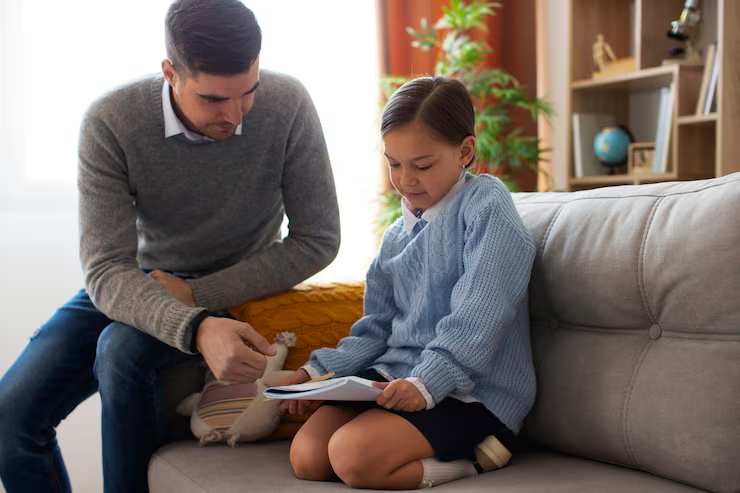
Every child gets frustrated from time to time.
A homework assignment feels too difficult. A sibling will not share. A video game level seems impossible to beat. A parent says no. A friend hurts their feelings.
Frustration is a normal part of life.
However, some children become frustrated much more quickly and intensely than others. Small obstacles can lead to tears, anger, meltdowns, or complete shutdowns. Parents often wonder why their child struggles with situations that other children seem to handle more easily.
As a therapist who has worked with children and families for more than twenty years, I often reassure parents that frustration is not the main problem. The real challenge is helping children learn how to tolerate frustration, recover from setbacks, and keep going when things do not go as planned.
Frustration tolerance is a skill that can be learned and strengthened over time.
What Is Frustration Tolerance?
Frustration tolerance refers to a person’s ability to handle challenges, disappointments, obstacles, and delays without becoming overwhelmed.
Children with strong frustration tolerance can:
- Manage disappointment
- Persist through challenges
- Recover from mistakes
- Adapt when things do not go as planned
- Solve problems more effectively
Children with low frustration tolerance often struggle with even small setbacks. They may:
- Become emotionally overwhelmed
- Give up quickly
- React with anger or tears
- Avoid difficult tasks
Why Some Children Become Frustrated So Easily
There is no single reason. Several factors often play a role.
Anxiety
Anxious children often carry a high level of internal stress. When challenges appear, they have less emotional space to cope.
Perfectionism
Perfectionistic children expect flawless performance. Mistakes feel much bigger than they are and can feel like failure.
Emotional regulation difficulties
Some children are still developing the ability to manage strong emotions. Frustration can quickly turn into outbursts or shutdowns.
Temperament
Some children naturally feel emotions more strongly. Their nervous system reacts more intensely to stress and frustration.
Limited experience with challenges
Children build frustration tolerance through practice. If they are shielded from every difficulty, they miss chances to learn resilience.
What Frustration Can Look Like in Children
Frustration may show up as:
- Frequent meltdowns
- Giving up quickly
- Crying easily
- Angry outbursts
- Arguing
- Refusing to try new things
- Negative self-talk
- Avoiding difficult tasks
- Perfectionism
- Blaming others
Some children act out. Others shut down. Both can signal difficulty managing frustration.
Why Frustration Tolerance Matters
Life includes many situations that do not go as planned:
- Mistakes
- Disappointments
- Delays
- Rejection
- Failure
- Conflict
- Unexpected changes
Children who learn to tolerate frustration are often better at:
- Solving problems
- Building confidence
- Managing anxiety
- Developing resilience
- Handling stress
- Learning new skills
What Parents Sometimes Do That Can Make Frustration Worse
Parents usually try to help, but some responses can make things harder.
Solving problems too quickly
Jumping in too fast removes chances for children to learn they can cope on their own.
Expecting instant calm
Many children need time before they can think clearly.
Criticizing emotional reactions
Phrases like:
- “You are overreacting”
- “It is not that hard”
- “Stop being dramatic”
often increase distress.
Focusing only on results
When outcomes matter more than effort, frustration tends to increase.
How to Help an Easily Frustrated Child
Stay calm
Children often take emotional cues from adults. Calm adults help children regulate better.
Validate feelings
Examples:
- “That was frustrating.”
- “I can see you are upset.”
- “This is hard for you right now.”
Validation does not remove expectations. It simply shows understanding.
Encourage problem-solving
Try questions like:
- What could you try next?
- What might help?
- What is one small step forward?
Praise persistence
Notice and praise:
- Effort
- Courage
- Flexibility
- Determination
- Problem-solving
Normalize mistakes
Mistakes are part of learning. Children need repeated reminders that struggle is normal.
Helping Perfectionistic Children
Perfectionistic children often struggle more with frustration. They may react strongly when:
- Work is not perfect
- They lose
- They receive feedback
- A task feels difficult
Helpful focus:
- Progress over perfection
- Effort over outcomes
- Learning over flawless performance
Teaching Coping Skills for Frustration
Children benefit from simple, practical tools.
Physical movement
- Walking
- Running
- Dancing
- Stretching
Deep breathing
Slow breathing helps calm the body and mind.
Taking a break
A short pause can help reset emotions.
Positive self-talk
Help replace:
“I cannot do this.”
with:
“This is hard, but I can keep trying.”
When Frustration May Be Linked to Anxiety
Frustration and anxiety often appear together. Anxiety can make children:
- Fear mistakes
- Dislike uncertainty
- Worry about failure
- Struggle with perfectionism
If frustration feels intense or frequent, anxiety may be part of the picture.
When Counseling May Help
Professional support can help if frustration:
- Leads to frequent meltdowns
- Causes family conflict
- Affects school performance
- Leads to avoidance
- Impacts friendships
- Increases anxiety
Counseling can support emotional regulation, coping skills, and confidence. For younger children, play-based approaches are often helpful.
Final Thoughts
Frustration is a normal part of life.
Children do not need to avoid it. They need support to learn how to handle it.
With time, guidance, and practice, children can learn to manage challenges, recover from setbacks, and keep moving forward even when things feel hard.
These skills support emotional health now and later in life.
Children who become easily frustrated often benefit from learning practical coping strategies. Discover simple techniques in How to Teach Coping Skills to Children and Teens.
At Amy Brown Counseling, we provide virtual counseling and online play therapy for children, teens, adults, and families throughout St. Louis and the state of Missouri. We also offer limited in-person sessions in Chesterfield. Our therapists help children develop emotional regulation skills, manage anxiety, improve self-esteem, navigate family changes, and build healthy coping strategies for life’s challenges.